

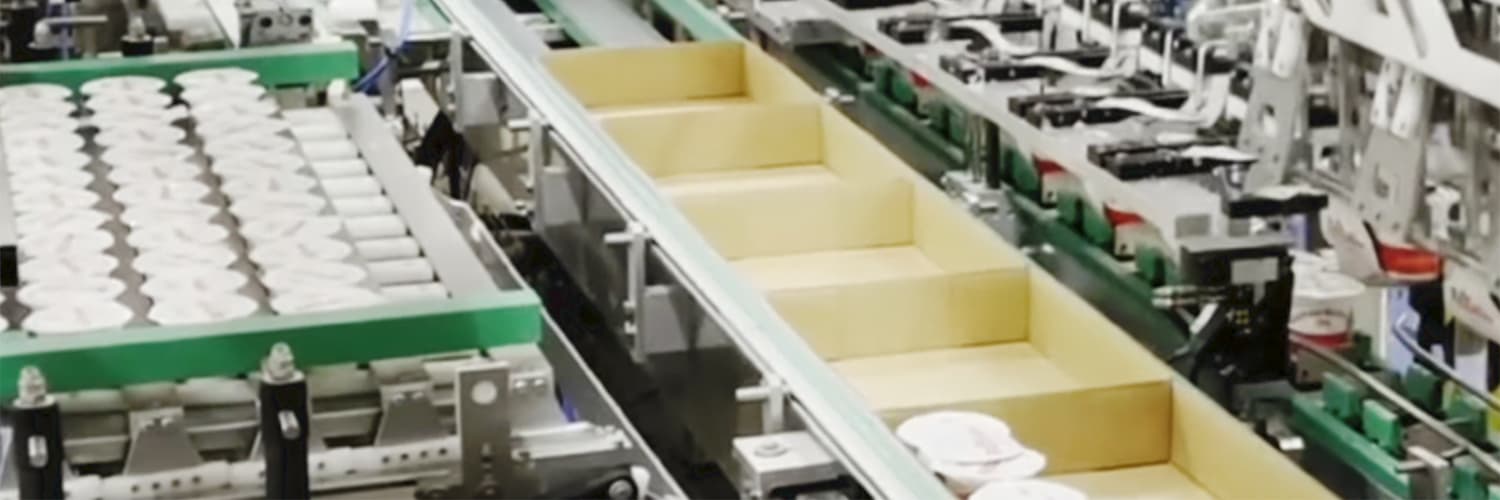

There is a quiet contradiction inside many high-performing dairy plants. Production lines are faster than ever. Filling is precise, reliable, and continuously improving. Output targets are met on paper. And yet, somewhere between the end of processing and the moment products leave the facility, performance begins to erode. Not dramatically. But enough to matter.
This is the part of the operation few talk about openly: the end of the line. And in many cases, it is where true capacity is either realized… or quietly lost.
Speed Without Flow Is an Illusion
A high-speed filler does not guarantee a high-performing line.
If products hesitate, accumulate, or require intervention after filling, then upstream speed becomes irrelevant downstream. What looks efficient is often a system compensating through manual effort, buffers, or workarounds that were never meant to scale. The real issue lies in how products transition from primary packaging into cartooning, case packing, cluster formation, and palletization. This is where flow is either protected or broken.
End-of-line performance is not defined by a single machine, but by how critical stages operate together under pressure: cartooning, promotional packing, case handling, and palletization.
When disconnected, friction is inevitable. Cartons fail to keep pace. Promotional packs disrupt rhythm. Case packing introduces variability. Palletizing becomes the final bottleneck, absorbing upstream inefficiencies. But when these stages are engineered as one continuous flow, the line stops fighting itself.
Wrap-around cartooning changes the role of secondary packaging entirely. Instead of slowing the line to maintain control, it allows packaging to form around the product in motion, reducing stops, stabilizing flow earlier, and minimizing unnecessary handling. Speed is no longer sacrificed at the packaging stage. It is sustained.
Promotional formats (multi-packs, bundled offers, seasonal configurations) are often treated as exceptions. They are introduced manually, or through temporary setups that interrupt flow and increase dependency on operators. But in high-performance environments, promotional packing is no longer an exception. It is part of the system.
When cluster packing is integrated into the line, products are grouped, combined, and stabilized in one continuous motion without breaking rhythm or introducing variability. Campaign-driven formats can be executed with the same consistency as standard production. The result is a line that supports commercial agility without sacrificing operational efficiency.
Case packing is where small inconsistencies become systemic problems. Misalignment, uneven grouping, and reactive handling rarely stop production but they quietly reduce performance over time. A more advanced approach imposes structure instead of reacting to flow. Every movement becomes controlled, repeatable, and predictable. Products are handled with precision, not correction. The result is stability across the entire line.
Palletization is often underestimated, yet it reveals the truth about the entire operation. If upstream flow is inconsistent, this is where it shows. If manual handling remains, variability returns at the worst possible moment.
But when palletization is fully integrated, it does more than keep up. It stabilizes output, absorbs speed, and removes one of the last dependencies on manual intervention. It turns the end of the line into a point of control, not compromise.
In dairy, hygiene cannot stop at filling. Fragmented end-of-line operations introduce exposure through handling, touchpoints, and open environments. An integrated approach reduces these risks by design, limiting intervention, controlling flow, and maintaining consistency from packaging to pallet. Even complex promotional formats are executed within controlled conditions, without added exposure.
At the same time, it unlocks hidden capacity. Lines run closer to their true potential, with fewer interruptions and greater predictability, without adding complexity or footprint.
The Advantage Few Will Admit
Some manufacturers have already made this shift. Not by adding more equipment, but by rethinking how the end of the line performs as a system, including how they handle variation, not just volume. The result is not always visible but it is measurable in efficiency, consistency, and control. And once achieved, it is difficult to replicate.
The future of dairy production will not be defined by how fast products are filled, but by how seamlessly they flow to final pallet. Wrap-around cartooning, integrated cluster packing, structured case handling, and palletization are not upgrades. They are how performance is protected, quietly, but decisively.